The Seduction of Certainty
Updated: Oct 5
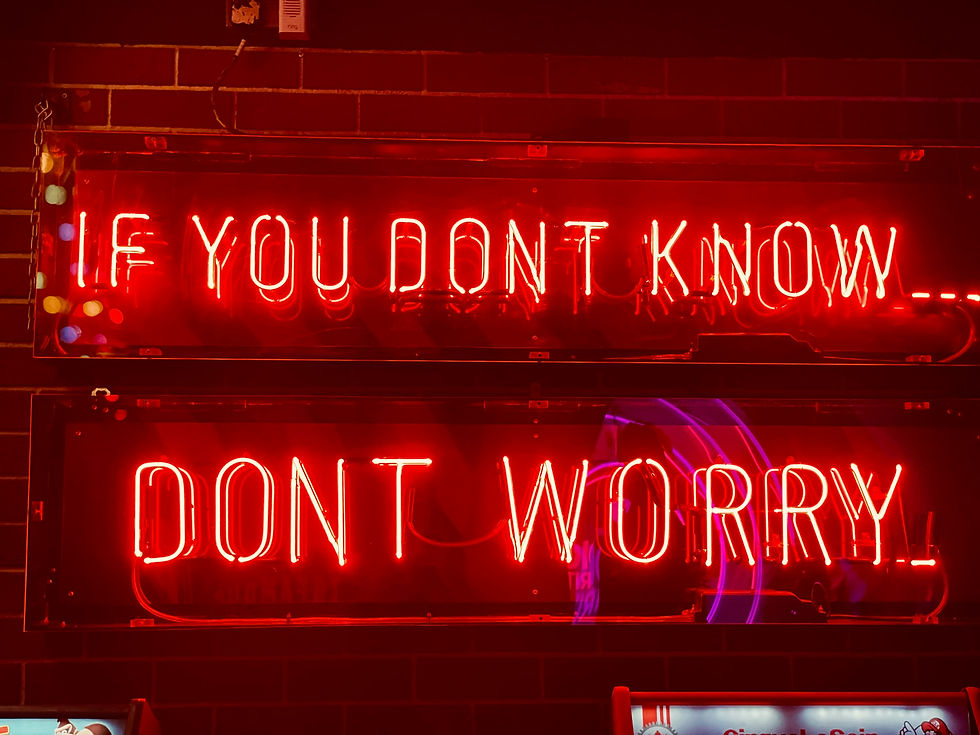
There’s something deeply comforting about certainty.
To know what’s true. To know who’s right. To know why something happened. To know what comes next.
Certainty gives the mind somewhere to stand.
For a long time, I was drawn to that feeling. I wanted answers that could settle my questions. I wanted ideas that made the world feel coherent. Spirituality offered plenty of them. Science offered others. Philosophy offered still more.
The problem wasn’t having answers.
The problem was what happened when I became attached to them.
I started noticing how easily an answer can become more important than the question that created it.
Once we decide we know, curiosity begins to disappear.
That’s where certainty becomes seductive.
The Comfort of Knowing
Our brains are remarkably good at creating patterns.
That ability is essential. Without it, the world would be an overwhelming collection of disconnected events. We recognize faces, predict outcomes, identify threats, learn from experience, and build models of the world around us.
The same machinery that helps us navigate reality can also make us uncomfortable with uncertainty.
Psychologists have studied this tendency extensively. Research by Arie Kruglanski and Donna M. Webster on the need for cognitive closure suggests that people differ in how strongly they prefer definite answers over ambiguity. When the need for closure is high, uncertainty can feel uncomfortable, and people may become more willing to accept an answer simply because it provides a resolution.
The important part is that the answer doesn’t necessarily have to be correct.
It just has to make the uncertainty stop.
That distinction matters.
Sometimes what feels like clarity is simply relief.
We Don’t Just Look for Answers. We Look for Confirmation.
Once we believe something, our relationship with information changes.
We become more attentive to evidence that supports the belief and more skeptical of evidence that challenges it.
This tendency is commonly referred to as confirmation bias.
In a classic 1960 study On the Failure to Eliminate Hypothesis in a Conceptual Task, psychologist Peter Wason demonstrated how readily people can be to search for information that confirms an existing hypothesis rather than information that could potentially disprove it.
The tendency isn’t limited to politics or religion.
It shows up in relationships.
In our opinions.
In the stories we tell about ourselves.
It can even show up in the way we interpret our own emotions.
If I believe someone doesn’t respect me, I’ll notice the moments that support that conclusion.
If I believe I’m fundamentally broken, I’ll notice every experience that seems to prove it.
If I believe the universe is sending me signs, coincidences can suddenly become evidence.
The mind doesn’t always ask, What else could explain this?
It often asks, How does this fit what I already believe?
That’s a very different question.
The Story Feels True Because It Fits
Human beings are storytellers.
We don’t experience our lives as disconnected data points. We connect events. We establish causes. We assign meaning.
Something happened.
Then something else happened.
We connect the two.
And a story emerges.
The story can become so familiar that we forget it’s a story.
This is one reason hindsight can be so convincing.
After an event occurs, the sequence often appears more predictable than it actually was. Psychologists call this hindsight bias.
Once we know the outcome, we have difficulty remembering how uncertain it felt beforehand.
This matters far beyond academic psychology.
Think about a major decision you’ve made in your life.
Afterward, the path can seem obvious.
You might tell yourself that the signs were there all along.
Maybe they were.
Or maybe you’re simply reconstructing the past through the lens of what you now know.
That distinction is almost impossible to feel from the inside.
The story feels true because it explains everything.
Certainty Can Become an Identity
There’s another layer to this.
Sometimes we don’t simply believe an idea.
We become someone who believes the idea.
We form an identity around it.
That changes things, dramatically.
A belief can be questioned.
An identity feels like it has to be defended.
This is where intellectual disagreement can become strangely emotional.
Someone challenges an idea, and it feels like they are challenging you.
The goal subtly changes from discovering what’s true to protecting who you are.
We see versions of this everywhere.
Political identities.
Religious identities.
Spiritual identities.
Even identities built around being skeptical of all of the above.
The irony is that rejecting one rigid ideology can become another form of ideology if we aren’t careful.
The problem isn’t really belief itself.
The problem is confusing a belief with reality.
Science Has a Different Relationship With Certainty
This is probably the number one reason I have come to appreciate science so deeply.
Science isn’t valuable because scientists always know the answer.
It’s valuable because the process is designed around the possibility that our current answer could be wrong.
A scientific claim is supposed to be vulnerable to evidence.
That vulnerability isn’t a weakness. It’s a strength.
A good scientific model doesn’t say, This is true because I believe it.
It says, in effect:
This explanation currently fits the evidence better than the alternatives. Let’s keep testing it.
That’s a very different relationship with knowledge.
Science doesn’t eliminate uncertainty.
It gives us better ways to navigate it.
There’s something profoundly honest about that.
The Danger of Turning Uncertainty Into a Problem
I think this is where certainty becomes particularly seductive in spiritual conversations.
Uncertainty can feel uncomfortable.
So we create explanations.
Everything happens for a reason.
The universe has a plan.
Your energy attracts your reality.
Everything is happening exactly as it should.
You are on your soul’s journey.
These ideas can be meaningful.
The problem begins when meaning becomes certainty.
There’s a difference between saying:
This way of seeing life helps me.
and saying:
This is how reality works.
The first is an honest description of personal meaning.
The second is a claim about the universe.
Those claims require evidence.
Without that distinction, spirituality can become another place where the desire for certainty disguises itself as wisdom.
I’ve become much more comfortable saying:
I don’t know.
It doesn’t mean I’ve stopped asking questions.
It’s because I’ve learned that an unanswered question is often more honest than a comforting answer.
Curiosity Is a Different Kind of Freedom
There’s freedom in curiosity.
Curiosity doesn’t require you to defend what you already know.
It allows you to look.
To investigate.
To change your mind.
To discover that maybe you misunderstood something.
To encounter evidence that makes you uncomfortable.
To say, I hadn’t considered that.
There’s humility in that sentence.
There’s also strength.
The person who needs to be certain has to protect the answer.
The person who’s curious only has to keep looking.
That distinction has changed the way I approach almost everything.
I don’t want beliefs that make me feel safe.
I want an understanding that can survive being questioned.
I don’t want certainty for its own sake.
I want clarity.
Those aren’t the same thing.
The Difference Between Clarity and Certainty
I know.
Clarity can say:
This is what I currently understand.
Certainty closes the door.
Clarity leaves it unlocked.
Certainty wants resolution.
Clarity can tolerate an open question.
Certainty protects the conclusion.
Clarity protects the process of seeing.
That doesn’t mean living in perpetual doubt.
There are things we can know with remarkable confidence.
The point isn’t to treat every claim as equally uncertain.
It’s to let the strength of our confidence correspond to the strength of the evidence.
Some things deserve conviction.
Some deserve skepticism.
Some deserve curiosity.
Some deserve a simple:
I don’t know yet.
That may be one of the most honest sentences we can learn to say.
What Remains When You Stop Needing to Know
The strange thing about loosening your grip on certainty is that the world doesn’t become less meaningful.
It becomes more interesting.
You begin to notice how much of your experience was being filtered through conclusions you had already reached.
You start seeing the difference between what happened and the story you built around what happened.
You begin to notice when you’re defending an identity rather than examining an idea.
You become more comfortable changing your mind.
You become more comfortable being wrong.
You become more comfortable not knowing.
There’s something deeply human about that.
We don’t need to have everything figured out to live meaningful lives.
We don’t need a cosmic explanation for every coincidence.
We don’t need to turn every painful experience into a lesson.
We don’t need to know exactly where everything is going.
We can simply remain present enough to keep discovering.
Maybe that’s what freedom looks like.
Not finally finding the answer that makes every question disappear.
Becoming the kind of person who no longer needs every question to have an answer.
Certainty may give us somewhere to stand.
Curiosity gives us somewhere to go.


